


You have calculated your Zakat. You know the amount. But here is the question that keeps many Muslims awake: where should it actually go?
A 2025 study in the Journal of Islamic Accounting and Business Research found that trust in a Zakat institution is the single strongest factor influencing whether Muslims pay through an organisation or distribute directly. The concern is real. Donors want certainty that every pound reaches those who deserve it, not an office budget.
This guide breaks down exactly what to look for in a Zakat-eligible charity, the red flags to avoid, and how organisations like Mercy Outreach Global meet the standard. By the end, you will know how to give your Zakat with complete confidence.
What Makes a Charity Zakat-Eligible?
Not every charity can receive Zakat. Islamic jurisprudence is specific about where these funds may go. The Quran (Surah At-Tawbah, 9:60) outlines eight categories of eligible recipients:
- The poor (Al-Fuqara): Those who lack basic necessities.
- The needy (Al-Masakin): Those who have some income but cannot meet essential needs.
- Zakat administrators (Al-Amilina Alayha): Those employed to collect and distribute Zakat.
- Those whose hearts are to be reconciled (Al-Mu'allafatu Qulubuhum): New Muslims or those sympathetic to Islam.
- Those in bondage (Fir-Riqab): Freeing captives or those in modern debt slavery.
- The debt-ridden (Al-Gharimin): Those overwhelmed by legitimate debt.
- In the cause of Allah (Fi Sabilillah): Supporting community welfare and da'wah.
- The wayfarer (Ibn As-Sabil): Stranded travellers without resources.
A trustworthy Zakat charity will clearly state which categories it serves and provide evidence of disbursement within them. If an organisation cannot tell you precisely who receives your Zakat, that is your first warning sign.
Expert note: The Muslim Charities Forum, a UK network of British Muslim charities, advocates for sector-wide accountability standards including Zakat-specific compliance frameworks.
The 100% Donation Policy: What It Really Means
A 100% donation policy guarantees that every penny of your Zakat reaches beneficiaries directly. No deductions for admin, marketing, or salaries.
How does a charity function on zero admin deductions?
- Operational costs are funded through a separate institutional fund or corporate sponsors.
- Dedicated supporters contribute specifically to running costs.
- Gift Aid reclaims from HMRC cover administrative overheads.
- Grants from foundations fund organisational infrastructure.
Mercy Outreach Global operates with this principle at its core. Their Impact Fund exists specifically to cover coordination, logistics, and response systems, keeping Zakat and Sadaqah donations ring-fenced for direct beneficiary support.
A practical example: When you donate £100 in Zakat to Mercy Outreach Global, that £100 goes to eligible recipients in places like Gaza, Yemen, Sudan, India, or Pakistan. The systems that make delivery possible are funded separately.
Not all charities adopt this model. Islamic Relief, for instance, openly explains why they do not use a 100% donation policy, arguing that investing in operational capacity improves long-term impact. Both approaches are valid, but for donors who want full pass-through assurance, a 100% policy offers the clearest peace of mind.
Five Signs of a Transparent Zakat Charity
Transparency is not a buzzword. It is measurable. Here is what to check before you donate:
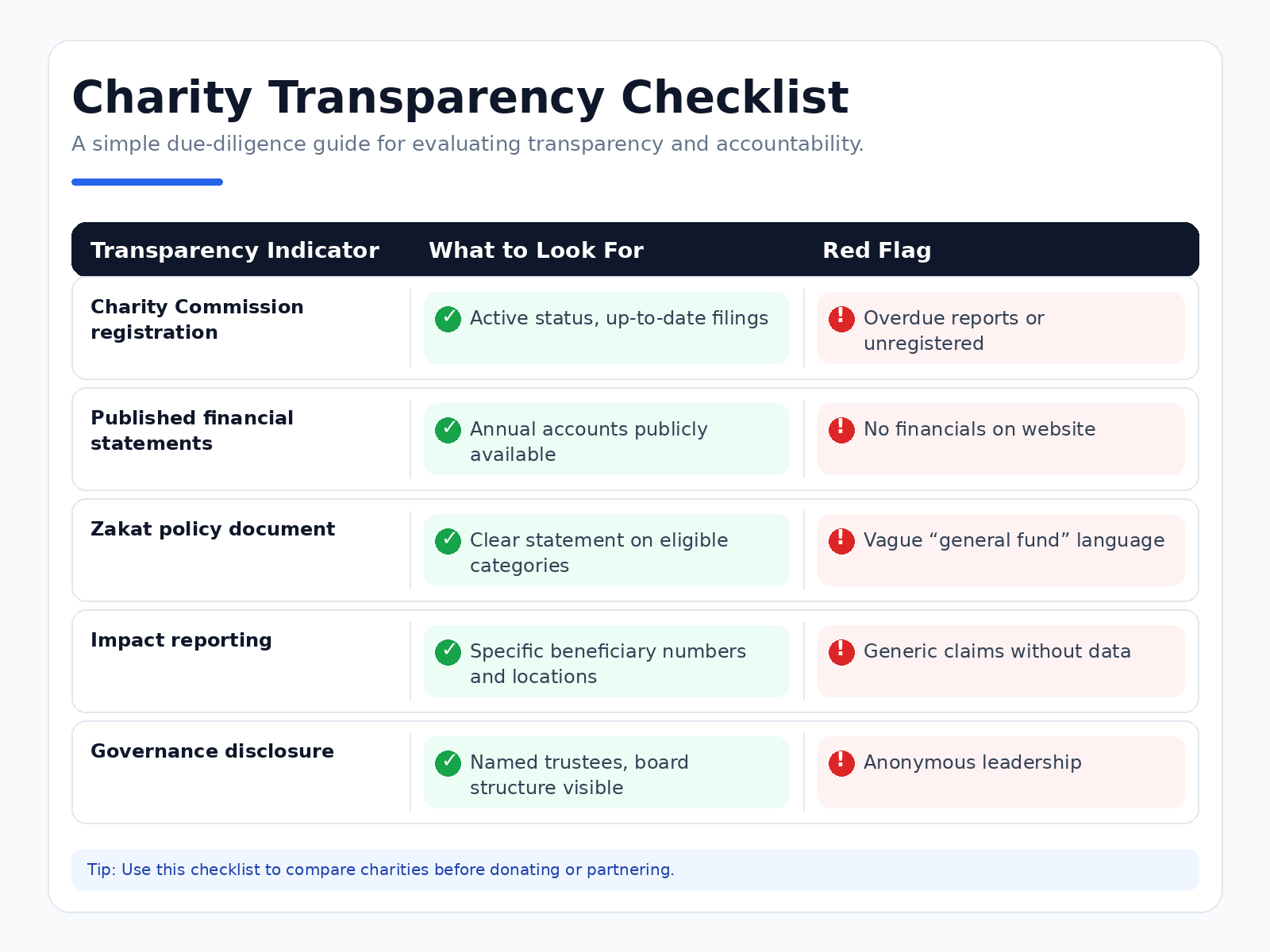
- Check the Charity Commission register for filing history.
- Example: National Zakat Foundation (Charity No. 1153719) reported £10.17 million in income for 2024, all publicly accessible.
- Look for named programmes tied to Zakat categories.
- Confirm the charity separates Zakat funds from general donations.
- Verify whether independent auditors review their accounts.
- Check if impact reports include geographic and demographic breakdowns.
Mercy Outreach Global states its commitment to transparency publicly, noting that funds are allocated across humanitarian programmes with accountability so supporters can "give with confidence."
Why Mercy Outreach Global Is a Trusted Option
Mercy Outreach Global is a UK-registered humanitarian organisation serving vulnerable communities across India, Pakistan, Malaysia, the Philippines, Mauritania, and Tanzania. Here is what sets them apart for Zakat donors:
Zakat-specific fund allocation. They maintain a dedicated Zakat fund separate from Sadaqah and general donations, ensuring your obligatory charity reaches only eligible recipients.
Operational costs covered independently. The Impact Fund supports coordination, compliance, and delivery systems, meaning your Zakat is not diluted by overheads.
Direct beneficiary focus. Programmes span emergency relief, food packs for families facing hunger, special cases (medical emergencies, urgent debt relief, shelter), and support for widows and orphans, all falling within recognised Zakat-eligible categories.
Verified by third parties. Their LaunchGood campaigns carry "Zakat-verified" status, providing an additional layer of external validation.
Accessible giving. Donors can allocate Zakat directly through their website, with clear cause selection and transparent reporting on where funds are deployed.
How to Verify Any Zakat Charity Yourself
Before donating, run through this quick checklist:
- Search the charity on the Charity Commission website and confirm active, up-to-date status.
- Read their Zakat policy. Does it reference the eight Quranic categories explicitly?
- Check whether Zakat funds are ring-fenced or pooled with general donations.
- Look for published impact reports with specific numbers (families fed, individuals supported, locations served).
- Confirm whether the charity has an independent auditor reviewing its accounts annually.
Clarifying Q&A:
Q: Can I give Zakat to a charity that does not have a 100% donation policy?
A: Yes. Scholars differ on whether administrative costs can be deducted from Zakat (the "Amilin" category permits payment to Zakat workers). However, if certainty matters to you, choose a charity that guarantees full pass-through.
Q: Is it better to give Zakat locally or internationally?
A: The strongest scholarly position is that Zakat should prioritise those closest to you first. However, many UK-based charities distribute both domestically and internationally. Choose based on where the need is greatest and where you trust the delivery mechanism.
The Research Behind Trust and Zakat Giving
Academic research consistently shows that transparency and accountability are the primary drivers of Zakat compliance through institutions.
A 2025 study published in the Journal of Islamic Accounting and Business Research found that trust moderates the relationship between intention and actual Zakat payment. When donors trust an institution, they are significantly more likely to pay through it rather than distribute independently.
Similarly, research by Jamaludin et al. (2025) on trust-building in Zakat institutions confirmed that perceived accountability, governance quality, and clear disbursement reporting are the three pillars donors evaluate, consciously or not.
The takeaway is straightforward: charities that show their working earn donor loyalty. Those that do not lose it to direct distribution.
Conclusion
Choosing where to donate your Zakat is both a spiritual and practical decision. Look for Charity Commission registration, a clear Zakat policy aligned to Quranic categories, ring-fenced funds, transparent reporting, and ideally a 100% donation policy. Mercy Outreach Global ticks these boxes with dedicated Zakat allocation, independently funded operations, and verified programmes across multiple countries. Your obligation deserves that level of care. Pay your Zakat with Mercy Outreach Global today and give with full confidence that every penny reaches those who need it most.